Design challenges
AI by students, for students
Some of the most interesting AI work here comes from students in a course and a summer internship. They sit with the people they are designing for, find where learning breaks down, and build the tool they wish they had. What they make is early. What they understand about the problem runs deep.
center 80% 0 0 #FFF0F7 2 warm pink divider 100% center 3pxFall 2025
Students partnered with peer tutors
Last fall, OpenStax founder and director Richard Baraniuk turned his ELEC 631: Rice Human/AI Teaming in Education course, into a design challenge, co-taught with Lorenzo Luzi and Debshila Basu Mallick. Graduate and undergraduate teams partnered with the Office of Academic Support for Undergraduate Students to learn how peer tutoring works and where it strains. Then they designed. Working in rapid prototyping environments, five teams developed AI tools based on their learning.
70% centerSchrödinger's Chat
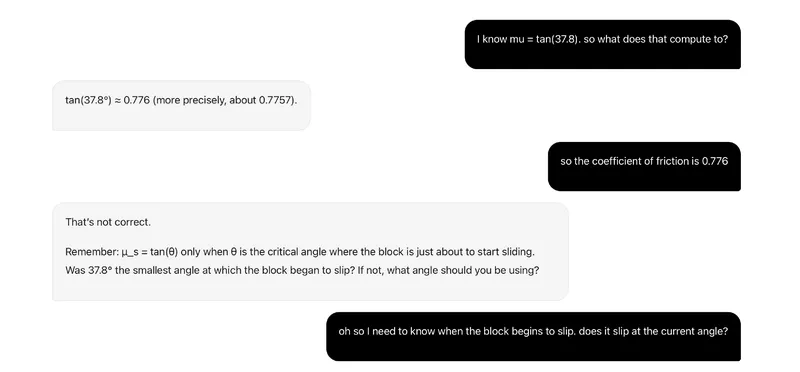
Help that doesn't do the thinking for you
Before a midterm, more students arrive at the tutoring center than one tutor can reach. Schrödinger's Chat is a physics tutor that works in that gap, asking students questions rather than answering theirs while they reason through a problem. Problems generate fresh each time, so there is nothing to memorize. Afterward the student gets an account of how they reasoned, and the tutor sees the same account.
Working prototype, deployed.
Thomas Walker, Johaun Hatchett
oAIsis
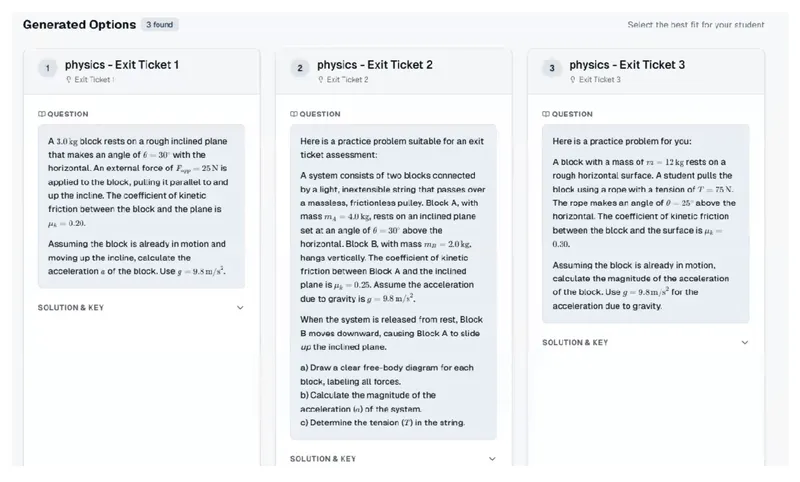
As much practice as a student needs
Solving one problem does not mean a student has learned the method, and tutors had no time to write more versions. oAIsis generates new versions of a problem a student just worked, different numbers and the same method, plus a short exit ticket to check whether the concept landed. Every request returns three options and the tutor picks one.
Working prototype, live.
Owen Pannucci, Eric Yang, Monica Lee
OAssistant
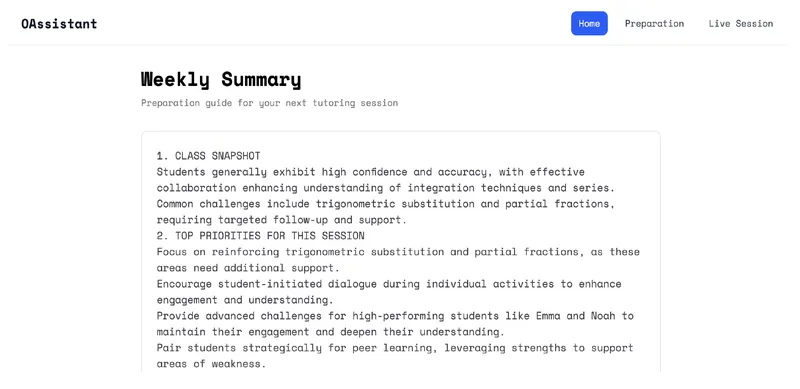
Every session builds on the last one
A tutor, right after a session, marks how each student did. Accuracy, confidence, how well they worked with others. That becomes next week's starting point: a summary of where each student stands and practice questions aimed at what they found hard.
Working prototype, deployed.
Tyler Wu, Michael Yu, Dora Zivanovic
Lumina
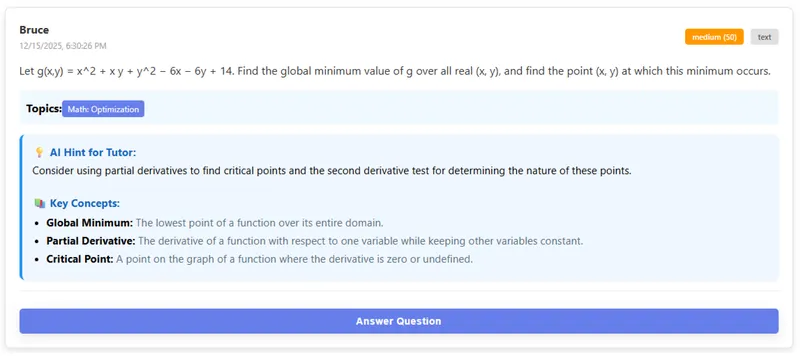
One tutor can reach a full room
Several students work the same problem and wait separately for the tutor to reach each of them. Lumina gives a session a shared question queue where students post as they work, by typing, photographing their work, or speaking. It groups questions by topic and shows which ones the room most needs, so a tutor answers once to everyone stuck on it.
Working prototype, deployed.
Bruce Tian, Carl Zhang, Feng Luo
BIOS Collaborative Learning Hub
Waiting your turn becomes studying together
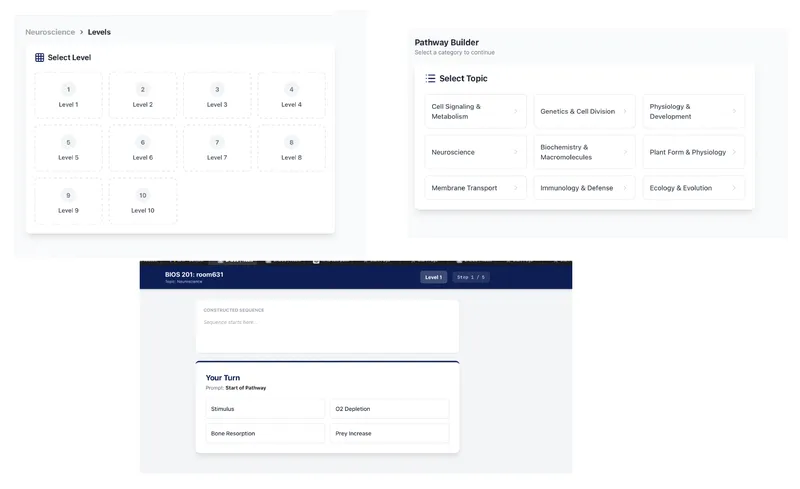
Students wait while the tutor helps someone else, and biology studying is mostly solitary. The Collaborative Learning Hub is a two-player game for BIOS 201 and BIOS 344 where students construct a biological pathway together or work a genetics crossword one clue at a time. There is no chat, so neither player can hand over an answer, and neither can finish alone.
Liza Jivnani, Aditya Chandra Mandal, Sreevidya Chintalapati
 #FFFFFF
3
rounded
masonry
#FFFFFF
#FFF0F7
to bottom
2
#FFFFFF
3
rounded
masonry
#FFFFFF
#FFF0F7
to bottom
2
Summer 2026
Student interns are designing from the textbook out
OpenStax interns are taking on a challenge with a broader aim: creating something from OpenStax content that can reach students anywhere.
center 0 0 70%Team DJ YAM
Choose-your-own-adventure videos
Reading about a hard conversation is not the same as being in one. This team turns textbook sections into branching video scenarios. A creator picks the section and describes the situation, the system drafts the characters, scenes, and decision points, and a person edits every piece before any video exists. In the demo, a nurse asks a man how he's feeling. He says he's fine, then crosses his arms when she mentions his test results. The student decides what she says next. Reassure him and he shuts down. Ask about the crossed arms and he tells her he's scared.
Working prototype, in development.
Darshan Singh, Justin Lee, Yousef Gehad, Ashley Niu, Mike Zhang
Team EdgeCase
Practice that finds gaps in learning
A student misses several questions in chapter ten, but the cause is rarely chapter ten. This team's system maps a textbook into its prerequisite structure, objective by objective rather than chapter by chapter, and follows a wrong answer backward until it finds the idea underneath, sometimes three or four chapters back. It pulls practice for that idea instead, and wrong answers sharing a root become one thing to fix. Instructors see the same map, so they can tell where a whole class is stuck.
Working prototype, in development.
Lazeen Rafik Manasia, Maahi Patel, Shichen Tang
Coming soon: Fall 2026
Rice students will reimagine the textbook
Next fall, we take it further. In a course taught by Rich Baraniuk with Lorenzo Luzi and Debshila Basu Mallick, students will take a single OpenStax textbook and ask how they would reinvent it for a world with AI in it. It is designed so students start designing in the first weeks, while the reading and the lectures come alongside the work.
The full shape is still coming together. The ambition is clear: hand students the thing millions of people learn from, and let them rethink it.
ELEC 631 Fall 2026 right 0 #F7FCFF warm pink divider center -3px 100% 3px